
You feel the itch first. Then the burning. And right in the middle of dealing with all that, you check the calendar and realize something else is off too: your period hasn’t shown up. So your mind naturally jumps to one question: can a yeast infection postpone your period?
It’s a fair thing to wonder. Your body feels off in more than one way at once, and it’s tempting to connect the two. Here’s the short version, which we’ll unpack below: a yeast infection doesn’t directly hold your period back. What’s actually happening is a little more layered than that.
What Exactly is a Yeast Infection?
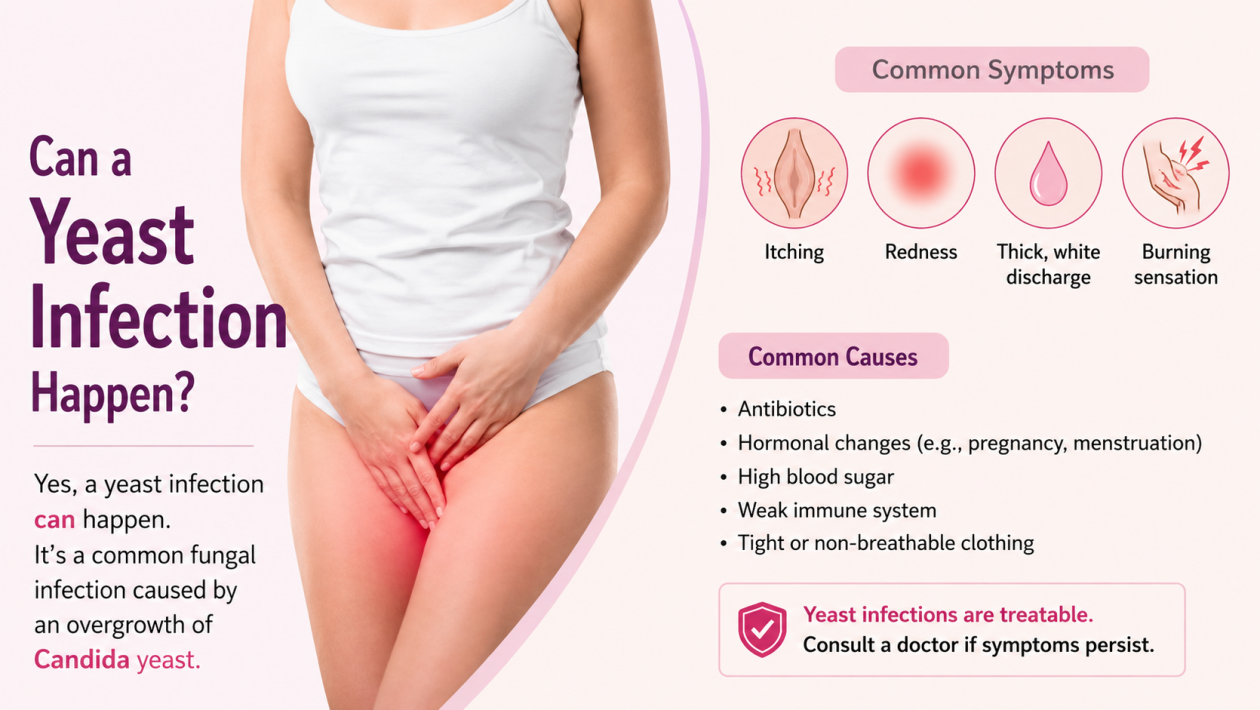
A yeast infection, medically known as vulvovaginal candidiasis, happens when a fungus called Candida albicans multiplies beyond its usual levels in the vagina. Normally, your vagina hosts a mix of bacteria and yeast that coexist peacefully. Something disrupts that balance, and the yeast takes over. Common triggers include:
- Antibiotic use
- Uncontrolled blood sugar
- A weakened immune system
- Tight or damp clothing
- Hormonal birth control
- A high-sugar diet
- Pregnancy, due to shifting vaginal pH
Symptoms You’ll Notice
- Intense itching around the vulva
- Burning during urination or sex
- Redness and swelling
- Thick, white discharge, often compared to cottage cheese
- General soreness in the vaginal area
None of these are hormonal symptoms. They’re localized to the vaginal tissue, not the reproductive cycle. That distinction matters once we talk about your period.
Can a Yeast Infection Postpone Your Period? The Direct Answer
No, a yeast infection does not postpone your period. Gynecologists are fairly unified on this. The infection lives in the vaginal tissue. Your menstrual cycle runs on a separate hormonal system entirely.
Here’s the chain that actually controls your period:
- Your hypothalamus and pituitary gland send signals to your ovaries
- Your ovaries respond by releasing an egg
- Estrogen and progesterone rise and fall to build up or shed the uterine lining
A fungal overgrowth in your vaginal canal has no access to that command center. It can’t interrupt this sequence. Many gynecologists note that if a period happens to run late around the same time as an infection, it’s usually coincidence rather than cause and effect. There’s no clinical research linking Candida overgrowth to menstrual delay in any direct, measurable way.
Two Separate Systems, Not One
Picture your reproductive health as two lanes running side by side. One handles hormonal ovulation, menstruation, the whole cycle. The other handles your vaginal environment, including pH and the microorganisms living there. A yeast infection stays in that second lane, and the lanes don’t cross. So if you’re wondering why your period is late while also dealing with itching, the infection almost certainly isn’t the reason. That said, the two aren’t complete strangers there’s a real reason they tend to overlap.

Why Do They Seem to Happen Together?
If a yeast infection has nothing to do with period timing, why does it feel like they show up as a package deal? The explanation comes down to hormones working in the opposite direction than you’d expect.
The Estrogen Connection
In the days before your period, estrogen levels shift as part of the normal luteal phase. This shift can change the vaginal environment just enough to let Candida multiply more easily. Your body essentially creates ideal conditions for yeast growth right around the time your period is due. So it isn’t that the infection delays your period; it’s the reverse. The hormonal buildup before menstruation is what makes you more prone to yeast overgrowth in the first place.
Coincidence, Not Causation
When two uncomfortable things happen the same week, your brain naturally links them. But correlation isn’t causation. Plenty of women get a yeast infection while their period still arrives on schedule; others get a late period with no infection at all. Overlap is common; it doesn’t prove one caused the other.
Stress as an Indirect Wildcard
Yeast infections aren’t pleasant. Ongoing itching and burning can genuinely stress you out, and stress is a legitimate disruptor of menstrual timing. Elevated cortisol can throw off the hormonal signals needed to trigger your period on schedule. So while the fungus itself doesn’t touch your cycle, the discomfort of dealing with it might in a roundabout way. This is really the only scenario where a yeast infection could be said to postpone your period, and even then, stress is the actual middleman.
Could the Treatment Be the Real Culprit?
If you’re still asking can a yeast infection postpone your period after treatment, the answer shifts slightly. Sometimes it isn’t the infection causing trouble; it’s the medication used to clear it. Most yeast infections are treated with antifungal creams, suppositories, or oral tablets like fluconazole, and for most women, these work quietly without touching the cycle at all. But a small number report cycle changes after oral antifungal treatment specifically, since it circulates through the bloodstream rather than staying localized.
The mechanism isn’t well documented, and it doesn’t happen to everyone. Still, if your period runs late, check the timeline: did it happen while you were untreated, or after starting medication? The second scenario points more toward the treatment. A one-time delay rarely means anything serious; a repeated pattern is worth mentioning to your doctor.
Other Things That Actually Delay Periods
Since yeast infections aren’t the real reason your period is late, here’s what actually moves the needle:
- Stress: Cortisol interferes with the hormones that trigger ovulation and menstruation.
- Weight changes or intense exercise: Your body needs stored energy for stable hormone production.
- Birth control changes: Starting, stopping, or switching methods almost always causes irregularity for a few months.
- PCOS or thyroid issues: These create a recurring pattern of late or missed periods, not a one-off delay.
- Pregnancy: Since symptoms can overlap with a yeast infection, this is worth ruling out with a test.
Yeast Infection or Early Pregnancy? How to Tell the Difference
This is probably the part you actually came looking for. When discharge, itching, and a late period show up together, pregnancy naturally crosses your mind, and the confusion makes sense, because the two conditions genuinely overlap.
Why the Overlap Happens
Early pregnancy causes a spike in estrogen and progesterone, which changes your vaginal environment in a way that resembles what happens right before your period. Higher estrogen increases sugar content in vaginal secretions, giving Candida more fuel to grow. That’s why some women notice a yeast infection right around conception, even though it isn’t a direct pregnancy symptom; it’s a side effect of the hormonal shift. Both early pregnancy and premenstrual changes happen during the same luteal phase, the stretch after ovulation and before your next period, the same hormonal window, overlapping symptoms.
Clues That Point One Way or the Other
| Symptom | Leans Toward |
| Thick, white, clumpy discharge | Yeast infection |
| Itching and burning | Yeast infection |
| Breast tenderness, nausea, fatigue | Early pregnancy |
| Symptoms intensifying as days pass | Early pregnancy |
| Symptoms improving with antifungal treatment | Yeast infection |
Testing Is the Only Sure Way
No combination of symptoms replaces an actual pregnancy test. Home tests can detect hCG a few days before your expected period, but testing after a missed period gives the most accurate result. Negative result, still no period? Wait a few days and test again.
When Should You See a Doctor?
Most yeast infections clear up within a week. Most late periods resolve on their own. But some situations call for an actual medical opinion:
- Your period is more than a week late with no clear explanation
- You’ve gone two full months without a period
- Symptoms don’t improve after a full course of over-the-counter treatment
- You’re getting yeast infections repeatedly, several times a year
- Discomfort is severe enough to interfere with daily life
- This is your first-ever yeast infection
Recurrent infections deserve a closer look, since they can point to uncontrolled blood sugar or a weakened immune response. It’s also worth ruling out look-alikes; bacterial vaginosis shares symptoms with candidiasis but comes with a distinct fishy odor and needs antibiotics, not antifungals. Trichomoniasis, a common STI, can also mimic yeast infection symptoms but requires different treatment. Self-diagnosing from symptoms alone can send you down the wrong path.

Tips to Support Vaginal and Menstrual Health
A few consistent habits go a long way:
- Wear breathable cotton underwear instead of synthetic fabrics
- Change out of wet swimwear or sweaty clothes promptly
- Skip scented soaps, douches, and vaginal sprays
- Keep blood sugar in check if you’re diabetic or prediabetic
- Limit unnecessary antibiotic use
- Track period dates alongside infection episodes; patterns become obvious fast
- Prioritize sleep, hydration, and stress management
Wrapping Up
So, can a yeast infection postpone your period? No, not directly. Your cycle runs on a hormonal system controlled by your brain and ovaries, while a yeast infection stays contained to vaginal tissue. They rarely interfere with each other directly.
What you’re seeing is mostly timing overlap, not causation. The same hormonal shifts that prepare your body for your period also create conditions where Candida grows more easily, which is why the two often show up together. Add occasional stress from discomfort, or a rare reaction to antifungal treatment, and the confusion makes sense.
A few days’ delay alongside a yeast infection usually isn’t cause for panic. Treat the infection, give your body time, and watch for patterns. But if your period is significantly late, if pregnancy is a possibility, or if infections keep recurring without explanation, get it checked. Clarity beats guessing every time.
FAQs
Q1. Can a yeast infection stop your period completely?
No. It affects vaginal tissue, not the hormonal system driving menstruation. If your period doesn’t arrive at all, look at pregnancy, stress, or a hormonal condition instead.
Q2. Can a yeast infection be an early sign of pregnancy?
Not directly, but it can coincide with pregnancy. Rising hormones make the vaginal environment more favorable to Candida growth. It’s not a confirmed pregnancy symptom on its own.
Q3. How long can a yeast infection delay ovulation?
It typically doesn’t. Ovulation is controlled by brain and ovarian signals, not vaginal fungal activity.
Q4. Does yeast infection medication affect your next cycle?
Usually not, though a small number of women report minor changes after oral antifungal treatment. A repeated pattern is worth discussing with your doctor.
Q5. Is it normal to get a yeast infection right before your period?
Yes. Estrogen shifts before menstruation create conditions that let yeast grow more easily.
Q6. When should I worry about a late period with a yeast infection?
If it’s more than a week late, if you’ve missed two cycles, or if pregnancy is a possibility, get it checked rather than assuming the infection is responsible.