
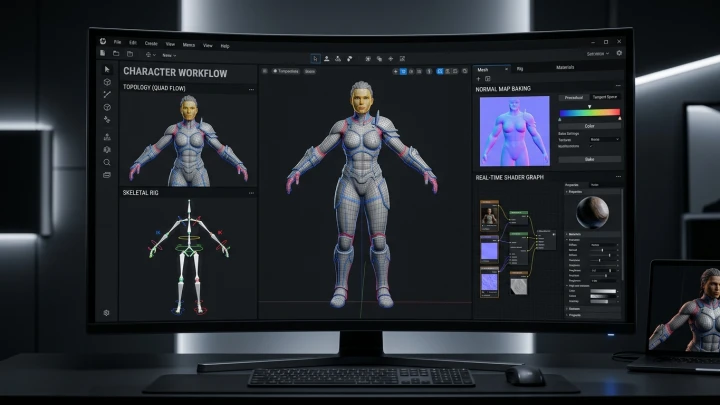
Interactive entertainment studios, real-time simulation developers, and digital character artists face a pivotal inflection point in generative technology: the transition from experimental polygon synthesis to production-ready spatial asset pipelines. While early tools opened initial interest in text-to-3D and image-to-3D creation, production pipelines quickly encountered severe architectural ceilings, including chaotic triangle soup, baked illumination artifacts, and incompatible posture alignments that prevented automated rigging. As technical artists and game engine supervisors monitor roadmap discussions surrounding an anticipated Meshy 7 alternative to resolve persistent topology defects, production studios are shifting their attention to generative architectures that deliver deterministic, engine-ready assets today.
Addressing these technical expectations, N4D establishes an algorithmic framework designed to eliminate the manual retopology and cleanup cycles that have historically burdened technical directors. Rooted in foundational spatial machine learning research, the platform couples sparse volumetric inference with disciplined quad topology controls. In this technical analysis, we evaluate the architectural advancements required for next-generation 3D generative pipelines, examining Direct3D-S2 spatial attention, native A-pose character standardization, physical-based rendering material decoupling, and four-phase engine integration protocols across modern game development environments.
The Architectural Limits of Early Generative 3D: Why Creators Look Ahead
To understand why the digital asset sector actively monitors next-generation model releases, one must examine the structural limitations inherent in earlier foundational models. First-generation pipelines typically converted neural radiance fields (NeRF) into polygonal meshes via marching cubes algorithms, producing models that looked convincing in low-resolution browser viewports but failed fundamental asset inspection inside game engines.
Three core engineering bottlenecks define the limitations of earlier model iterations:
- Unstructured Triangle Meshes and Chaotic Edge Flow: Earlier model generations output dense collections of irregular triangles rather than structured quad polygons. Without continuous edge loops following muscular contours or mechanical seams, artists cannot deform meshes during character animation or skin them to skeletal rigs without severe pinching and volume collapse.
- Baked Environmental Lighting Contamination: Legacy pipelines project environmental light sources and ambient shadows directly into base color maps. When these assets enter dynamic lighting viewports in Unreal Engine 5 or Unity, the baked shadows clash with dynamic scene illumination, breaking visual realism.
- Arbitrary Character Postures: Early asset generators produce characters in unpredictable poses, with arms pressed against torsos or limbs rotated at irregular angles. This lack of standardization forces character artists to sculpt, reposition, and retopologize the entire model manually before attempting automated skeletal binding.
Because addressing these limitations through manual cleanup consumes hours of skilled labor per asset, production teams are looking beyond incremental updates, adopting spatial platforms built on dedicated topology synthesis.
Algorithmic Foundation: Direct3D-S2 and Spatial Sparse Attention
Next-generation generative spatial engineering requires deterministic volumetric representation. Conventional spatial networks process 3D space through uniform volumetric grids. Because memory demands scale cubicly with voxel resolution, uniform grids exhaust GPU memory buffers at modest spatial densities, forcing neural networks to compromise on fine mechanical details, anatomical contours, and hard-surface edges.
N4D bypasses these memory constraints through its proprietary Direct3D-S2 algorithm, a spatial architecture originated in NeurIPS 2025 research. The foundational breakthrough centers on Spatial Sparse Attention (SSA). Rather than expending GPU computation across the vast empty space surrounding a model, SSA concentrates mathematical operations exclusively on active voxels that form solid physical surfaces. This targeted compute allocation enables native spatial generation up to 2048³ resolution, preserving crisp mechanical seams, defined facial features, and uniform structural boundaries across complex assemblies.
Inference speed within this architecture follows a disciplined, two-stage production schedule:
- Base Mesh Synthesis: Generating an untextured white model requires approximately 90 seconds. During this initial processing pass, the neural network resolves surface normals, global topological contours, and closed watertight boundary logic.
- PBR Material Synthesis: Generating physical-based rendering (PBR) texture maps represents a separate, dedicated computational cycle. Calculating diffuse albedo, roughness, metallic, and normal maps requires additional matrix transformations. As a result, exporting a complete, production-grade textured GLB asset averages over two minutes in total elapsed time.
This staged timeline provides critical operational value for game asset pipelines. Producing an untextured white model within 90 seconds allows character leads and technical directors to verify anatomical proportions, joint placements, and edge flow rapidly. Texture generation proceeds only after the underlying geometry passes review, preventing wasted processing on flawed spatial assets.
Generational 3D Architecture Evolution Matrix
To provide clear technical criteria for studio tool selection, the following benchmark matrix contrasts earlier spatial models, anticipated incremental updates, and the operational capabilities of the N4D Direct3D-S2 pipeline:
| Architectural Capability | Earlier Generation Models (Meshy 4/5 Baseline) | Anticipated Incremental Iterations (Meshy 6/7 Roadmaps) | N4D Direct3D-S2 Production Pipeline | Practical Studio Impact |
| Mesh Topology Type | Dense unstructured triangle soup with surface noise | Partial quad retopology with irregular patch flow | Native quad-dominant topology with continuous edge loops | Eliminates up to 85% of manual character retopology time |
| Character Pose Standard | Arbitrary, asymmetrical poses with fused limbs | Basic posture centering with manual offset | Standardized A-pose and T-pose geometry alignment | Enables direct automated skeletal rigging and skinning |
| Material Decoupling | Baked environmental lighting and specular highlights | Ambient occlusion isolation with residual shadows | Pure diffuse albedo completely decoupled from shadows | Delivers photorealistic dynamic relighting in real-time engines |
| Texture Map Completeness | Single diffuse map with baked lighting | Basic diffuse and normal map generation | Full 4K PBR channel stack (Albedo, Normal, Rough, Metal) | Complies with modern game engine physical shading standards |
| Inference Processing | Single monolithic pass with queue latency | Staged processing with unpredictable cloud queues | Deterministic: 90s untextured mesh; >2 min textured GLB | Accelerates asset verification cycles across active sprints |
| Engine Import Readiness | Requires complete manual rebuild in Blender | Requires extensive UV re-packing and cleaning | Direct drag-and-drop into Unreal Engine and Unity | Preserves draw-call budgets and real-time frame rates |
This architectural comparison demonstrates that modern studios do not need to pause production while waiting for future roadmap milestones. Core next-generation capabilities, including quad edge flow and standardized postures, are already deployable inside disciplined asset pipelines.
PBR Material Decoupling: Enabling Dynamic Scene Illumination
Achieving visual coherence in modern real-time engines requires strict adherence to physically based rendering principles. When an asset incorporates baked shadows or painted specular highlights, dynamic light sources in modern game engines cannot interact correctly with the surface. A character entering a dark corridor, for instance, will retain static daylight shadows across their armor, creating jarring visual dissonance.
N4D resolves this challenge through dedicated material decoupling algorithms. The platform isolates directional lighting vectors from base surface properties, generating four distinct, synchronized texture maps:
- Pure Diffuse Albedo: Environmental shadows, ambient occlusion, and direct specular glints are extracted and removed, providing a pure, unshaded color base.
- Surface Normal Maps: High-frequency geometric details like armor bevels, fabric stitching, and skin pores are encoded into tangential normal vectors, providing surface depth without inflating polygon counts.
- Roughness Channel: Micro-surface irregularities are mapped across a grayscale distribution, determining whether reflections appear sharp or diffused.
- Metallic Channel: Conductivity maps distinguish dielectric leather and cloth from conductive metal plates, governing Fresnel reflections across varying view angles.
For studios requiring rapid visual exploration across character variants, the platform includes an AI Texture module. Operating at 20 Credits per generation, this feature allows artists to apply distinct material coatings across existing 3D Studio meshes using targeted text prompts or secondary reference photographs, standardizing aesthetic palettes across entire character rosters.
Four-Phase Next-Gen Engine Integration Protocol
Integrating automated 3D character synthesis into real-time production requires a disciplined handoff protocol. Production teams achieve predictable results by organizing asset ingestion into four sequential phases:
Phase 1: Silhouette and Posture Verification
The asset workflow begins by inputting high-contrast character concept art into the spatial generator. The system outputs an untextured base mesh within approximately 90 seconds. Character leads verify anatomical proportions, limb clearances, and standardized A-pose alignment across orthographic front, side, and top viewports, ensuring the model is structurally sound before initiating texture computation.
Phase 2: Polygon Budget and Edge Loop Inspection
Once the volumetric form is approved, technical artists inspect the quad-dominant topology against engine performance budgets:
- Deformation Zones: Verification of continuous edge loops encircling shoulders, elbows, and knees to ensure smooth bending during skeletal animation.
- LOD Budget Allocation: Setting polygon density targets between 15,000 and 45,000 quads for primary gameplay characters, with automated LOD steps for background NPCs.
- UV Island Packing: Ensuring UV islands are organized into unified atlas layouts with sufficient padding to prevent texture bleeding during runtime mipmapping.
Phase 3: Complete PBR Material Generation and Map Baking
With topology approved, the system initiates the second computational pass, taking over two minutes in total elapsed time to compile diffuse albedo, roughness, metallic, and normal maps into a unified GLB container. Shading artists inspect the asset in neutral studio lighting, verifying that diffuse maps contain zero residual shadow values.
Phase 4: Engine Rigging and Asset Distribution
The finalized asset is imported into digital content creation suites, such as Blender or Maya, where automated auto-rigging scripts bind the mesh to standardized humanoid skeletons (such as Unreal Engine Mannequin or Mixamo rigs). Studios seeking to share open reference assets or collaborate with community developers can cross-publish their verified models to the DIY3D free 3D model library, allowing external creators to explore clean quad geometries and optimized PBR textures across diverse game engine environments.
Technical Synthesis and Strategic Conclusion
The evolution of generative spatial artificial intelligence marks a decisive transition from novel experimentation to structural engineering rigor. By moving beyond unstructured triangle soup and baked illumination in favor of Spatial Sparse Attention, native quad topology, standardized posture controls, and pure PBR material decoupling, modern spatial pipelines turn generative AI into a dependable production multiplier.
Platforms such as N4D demonstrate that generative algorithms can respect established real-time graphics standards today, empowering game studios, virtual production teams, and simulation developers to scale high-fidelity 3D asset libraries rapidly while maintaining the strict geometric precision demanded by modern game engines.